
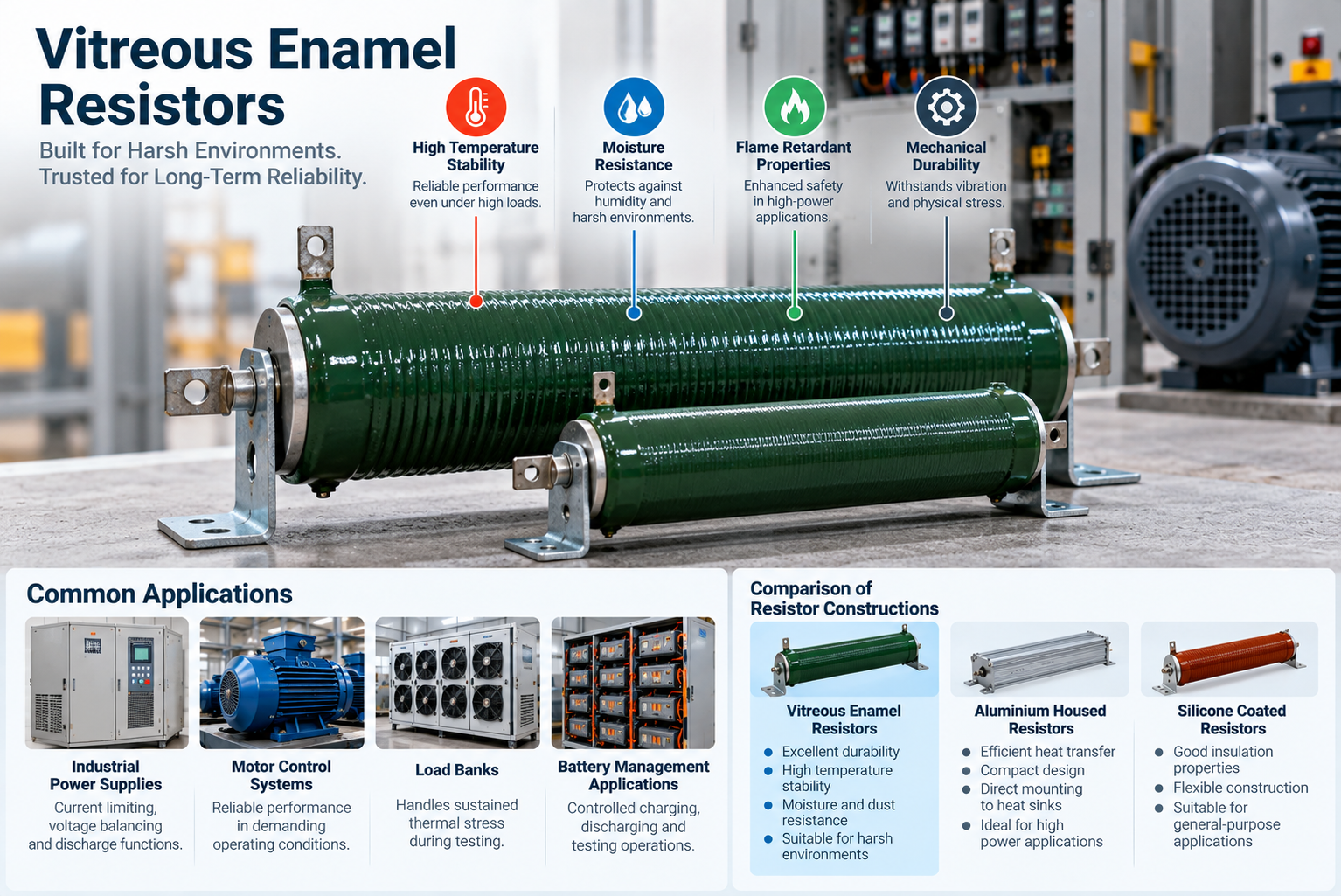
Some electrical components are designed for comfort. Others are built for survival.
Inside a climate-controlled electronic device, a resistor may operate for years without facing significant stress. But inside a motor control cabinet, a load bank or an industrial power supply, conditions are very different. Heat builds up. Loads fluctuate. Dust, moisture and vibration become part of everyday operation.
In these environments, reliability is not just about electrical performance. It is about how well a component withstands years of thermal and environmental stress.
This is where vitreous enamel resistors have earned their reputation. Long before power electronics became as advanced as they are today, these resistors were being trusted in demanding industrial systems. Decades later, they continue to be chosen for applications where durability, thermal stability and long service life matter more than anything else.
What Is a Vitreous Enamel Resistor?
A vitreous enamel resistor is a wire wound power resistor protected by a specialised glass-like coating known as vitreous enamel.
The manufacturing process begins with a resistive wire wound around a ceramic core. Once the winding is complete, a vitreous enamel coating is applied and fused at high temperatures, creating a hard protective outer layer.
This coating serves an important purpose. It protects the resistor from moisture, dust and mechanical damage while allowing it to operate reliably in demanding thermal conditions.
Unlike many general-purpose resistor constructions, vitreous enamel resistors are specifically designed for applications where environmental durability is as important as electrical performance.
Why Vitreous Enamel Construction Works So Well
The secret behind the long-standing popularity of vitreous enamel resistors lies in the coating itself.
High Temperature Stability
Power resistors are designed to convert electrical energy into heat. The more demanding the application, the more heat they must handle.
Vitreous enamel coatings remain stable at elevated temperatures, helping protect the resistor even during continuous operation under heavy loads.
Moisture Resistance
Industrial environments are rarely ideal. Humidity, condensation and airborne contaminants can gradually affect component reliability.
The enamel coating acts as a protective barrier, helping shield the resistor from environmental exposure and supporting long-term performance.
Flame Retardant Properties
Safety is a critical consideration in high-power electrical systems.
Because vitreous enamel is essentially a glass-based coating, it offers excellent resistance to heat and contributes to the overall safety and durability of the resistor assembly.
Mechanical Durability
Industrial equipment is often exposed to vibration, handling and physical stress during installation and operation.
The hardened enamel surface provides additional protection, helping the resistor maintain its integrity over extended service periods.
Where Vitreous Enamel Resistors Are Commonly Used
The best way to understand the value of a resistor is to look at where it is trusted to perform.
Industrial Power Supplies
Power supplies often require resistors for current limiting, voltage balancing and discharge functions. Reliability is essential because a failure can affect the entire system.
Motor Control Systems
Motor drives frequently generate heat and experience changing operating conditions. Vitreous enamel resistors provide dependable performance in these demanding environments.
Load Banks
Load bank applications are designed specifically to absorb electrical energy during testing and commissioning. The ability to handle sustained thermal stress makes vitreous enamel construction particularly suitable.
Battery Management Applications
Battery charging, discharging and testing systems require controlled power dissipation. Durable resistor construction helps ensure safe and consistent operation.
Across all these applications, the common requirement is dependable performance under demanding conditions.
Vitreous Enamel vs Aluminium Housed vs Silicone Coated Resistors
Every resistor construction has strengths, and selecting the right one depends on the application.
Vitreous Enamel Resistors
These are often chosen where durability, environmental protection and high-temperature operation are key priorities. They are well suited to industrial environments that demand rugged performance.
Aluminium Housed Resistors
Aluminium housed resistors excel in applications where heat transfer is critical. Their metal casing allows efficient thermal conduction and direct mounting to heat sinks.
Silicone Coated Resistors
Silicone coated designs are commonly used in general-purpose applications where flexibility and insulation are required, but they are typically selected for different operating environments.
Rather than one technology replacing another, each serves a specific engineering requirement.
What Quality Engineers Should Look For
Two vitreous enamel resistors may appear identical from the outside, yet perform very differently over time.
When evaluating resistor quality, engineers should look beyond resistance values and power ratings.
Important considerations include:
- Precision winding accuracy
- High-quality resistance alloys
- Durable ceramic core construction
- Uniform enamel coating
- Proven overload capability
- Consistent thermal performance
- Thorough quality control procedures
These factors play a major role in determining how a resistor performs after years of operation in the field.
For a broader understanding of resistor technologies, explore our article on Power Resistors Explained: Applications, Types and Why Quality Matters.
If you are evaluating options for a specific design, our guide on How to Select the Right Power Resistor for Your Circuit provides additional practical insights.
Vitreous Enamel Resistors from PEC Manufacturing Company
At PEC Manufacturing Company, we understand that power resistors are often required to operate in environments where failure is not an option.
Our resistor solutions are manufactured using carefully selected materials, precision winding processes and rigorous quality standards to ensure dependable performance under demanding industrial conditions.
Whether used in motor control systems, power supplies, load banks or energy management equipment, our vitreous enamel resistor solutions are designed to deliver the durability, thermal stability and long operational life that modern industrial applications demand.
Conclusion
Not every power resistor faces harsh operating conditions, but the ones that do require a construction designed to withstand them.
Vitreous enamel resistors have remained a trusted choice across industrial applications because they combine proven wire wound technology with exceptional environmental protection, temperature stability and mechanical durability. Their ability to perform reliably under heat, moisture and continuous electrical stress makes them a dependable solution for demanding power applications.
At PEC Manufacturing Company, we manufacture resistor solutions engineered for reliability in challenging industrial environments. Whether you are designing a motor control system, load bank or power conversion application, our team can help identify the right solution for your requirements.
Request a vitreous enamel resistor datasheet or sample to evaluate the best option for your application.
Also Read: Power Resistors Explained: Applications, Types, and Why Quality Matters