
Introduction
Most electrical failures do not happen during normal operation.
They happen in the first few milliseconds.
A power supply is switched on. A large capacitor bank begins charging. A motor starts after sitting idle for hours. Everything appears routine, yet for a brief moment, the circuit experiences a surge of current far greater than its normal operating level.
This surge is known as inrush current, and although it lasts only an instant, it can place enormous stress on components. Capacitors, contactors, relays, fuses and semiconductor devices are often forced to absorb currents many times higher than their rated values.
Engineers spend considerable time designing systems that operate efficiently at full load. Yet protecting equipment during startup is equally important. This is where inrush resistors play a critical role.
While rarely visible to end users, these components quietly protect electrical systems every time power is applied, helping ensure reliability, safety and longer equipment life.
What Is Inrush Current?
Inrush current is the temporary surge of current that occurs when electrical equipment is first energised.
Unlike normal operating current, which remains relatively stable, inrush current can be several times higher than the circuit’s rated current.
One of the most common examples occurs when charging large capacitors.
An uncharged capacitor initially behaves almost like a short circuit. As soon as power is applied, a large current rushes into the capacitor until the voltage reaches its operating level.
A similar effect occurs during motor startup. Before the motor reaches operating speed, it draws substantially higher current than during normal running conditions.
Although brief, these current surges can generate heat, mechanical stress and electrical wear that gradually reduce component lifespan.
Why Inrush Current Can Be Damaging
Imagine opening a fire hydrant instead of a household tap every time you wanted a glass of water.
That is essentially what many electrical components experience during startup without adequate protection.
Excessive inrush current can result in:
- Premature capacitor ageing
- Contact welding in relays and contactors
- Fuse nuisance tripping
- Increased stress on semiconductor devices
- Transformer saturation
- Reduced equipment lifespan
Repeated exposure to high startup currents often causes gradual damage that remains unnoticed until unexpected failures occur later.
Controlling inrush current therefore becomes an important part of system protection rather than simply a performance improvement.
How an Inrush Resistor Works
The solution is surprisingly straightforward.
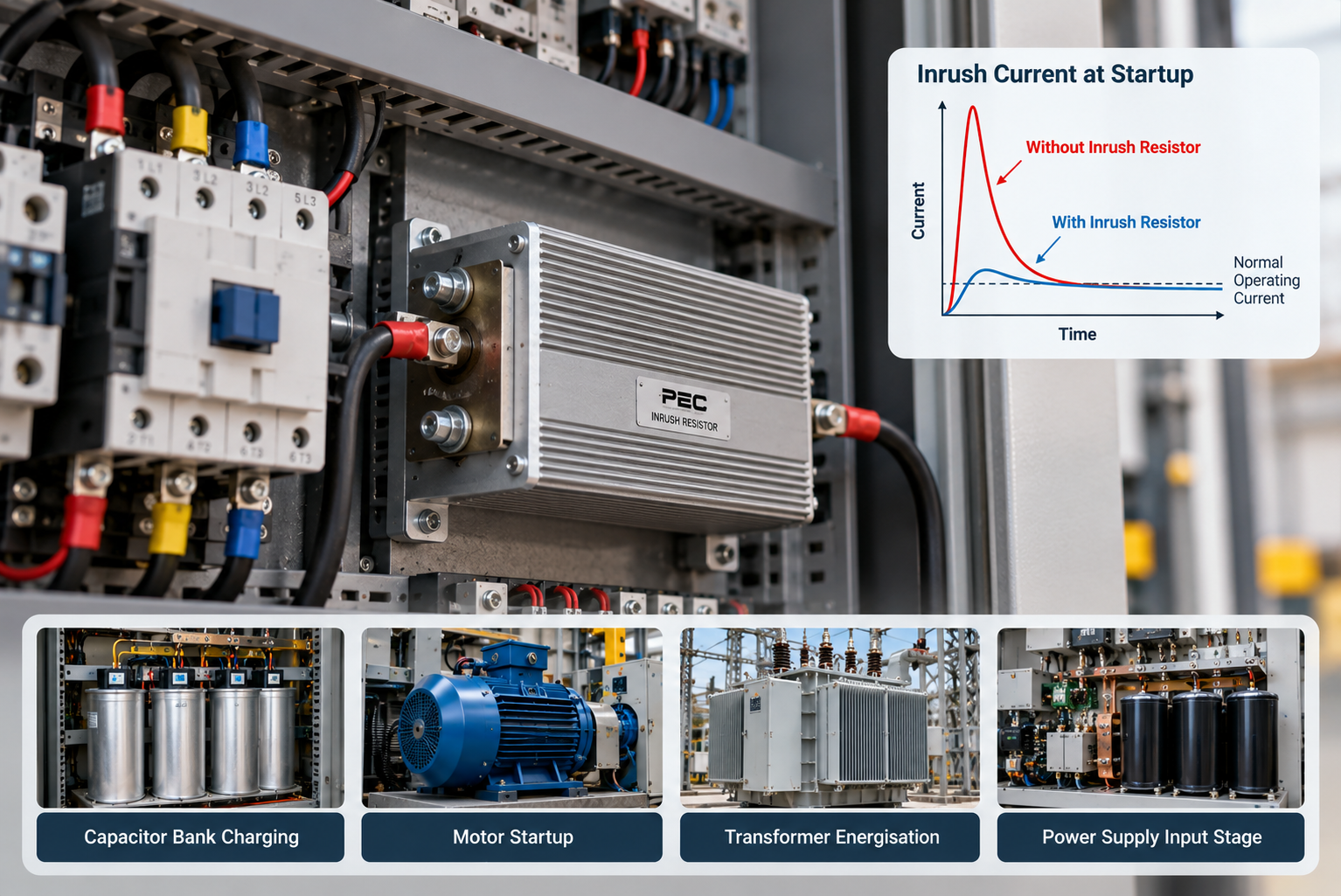
An inrush resistor is temporarily connected in series with the circuit during startup. The resistor limits the initial surge current, allowing capacitors, motors or transformers to energise in a controlled manner.
Once charging or startup is complete, the resistor is typically bypassed using a relay, contactor or switching device.
The resistor only performs its function during those critical startup moments when protection is needed most.
By reducing peak current levels, the circuit experiences less stress and operates more reliably over time.
Common Applications for Inrush Current Limiting
Inrush resistors are widely used wherever large startup currents occur.
Capacitor Bank Charging
Large capacitors used in power electronics can draw extremely high currents during initial charging. Inrush resistors provide controlled charging and help protect both capacitors and switching devices.
Motor Startup
Industrial motors often require significantly higher current during startup than during normal operation. Inrush protection reduces electrical stress on the motor control system.
Transformer Energisation
Transformers can generate substantial inrush currents when first energised due to magnetic core characteristics. Current limiting resistors help reduce these startup surges.
Power Supply Input Stages
Modern power supplies frequently incorporate large capacitors that require controlled charging to avoid excessive stress on rectifiers and switching components.
In all these applications, the goal remains the same: control the surge before it becomes a problem.
Inrush Resistors vs NTC Thermistors
Both inrush resistors and NTC thermistors are used to reduce startup current, but they achieve this in different ways.
NTC Thermistors
NTC thermistors begin with high resistance when cold and gradually reduce resistance as they heat up.
They offer a simple and economical solution for many applications but may be less effective in systems with frequent on-off cycling because they require cooling time before returning to their high-resistance state.
Fixed Inrush Resistors
Power resistors provide predictable and repeatable performance regardless of operating cycles.
When combined with a bypass relay or contactor, they offer precise current control and are often preferred in higher-power industrial applications where reliability is critical.
The appropriate choice depends on system requirements, operating conditions and power levels.
Selecting the Right Inrush Resistor
Choosing an inrush resistor involves more than selecting a resistance value.
Engineers must consider:
- Maximum inrush current
- Supply voltage
- Capacitor size or motor characteristics
- Energy absorption requirements
- Duty cycle
- Pulse loading capability
- Operating temperature
An undersized resistor may overheat or fail prematurely, while an oversized resistor can unnecessarily increase charging time and affect system performance.
Proper sizing ensures both protection and operational efficiency.
For a deeper understanding of capacitor charging applications, read our articles Why Use a Capacitor Charging (Pre-Charge) Resistor? Working Principle, Use Cases and Best Practices and What Is a Precharge Resistor? Role, Applications and Benefits.
Inrush Protection Solutions from PEC Manufacturing Company
PEC Manufacturing Company manufactures resistor solutions designed for demanding startup and energy management applications.
Our resistor range includes solutions suitable for capacitor charging, precharge circuits, inrush current limiting and industrial power systems where controlled energisation is essential.
Built using high-quality materials and precision manufacturing processes, these resistor solutions are engineered to provide dependable performance, effective energy absorption and long operational life across a wide range of industrial applications.
Conclusion
The most stressful moment in an electrical system’s life is often the instant it starts.
Without protection, inrush current can place significant strain on capacitors, motors, transformers and switching devices, gradually reducing reliability and increasing maintenance costs. Inrush resistors provide a simple yet highly effective solution by limiting startup current and allowing equipment to energise in a controlled manner.
Whether protecting capacitor banks, motor drives, transformers or power supply systems, properly selected inrush resistors play a critical role in improving equipment lifespan and operational reliability.
At PEC Manufacturing Company, we provide resistor solutions engineered for dependable inrush current control in demanding industrial environments.
Talk to our engineering team about the right inrush protection solution for your application.