
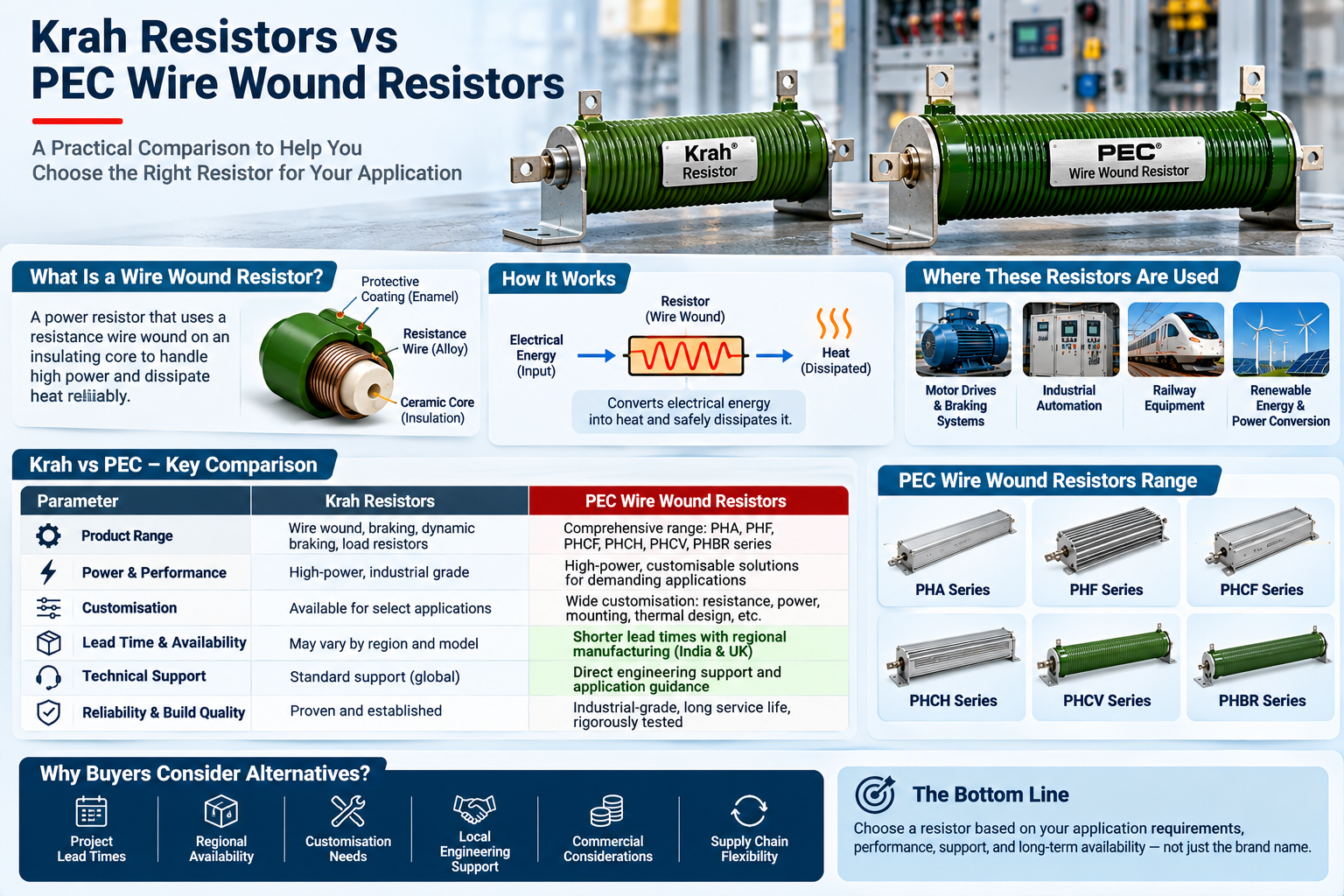
Introduction
The search often begins with a part number.
A maintenance engineer needs a replacement resistor. A procurement team is looking for an approved alternative supplier. An OEM is evaluating options for a new project while trying to balance performance, lead time and cost.
The name “Krah resistor” frequently appears in these situations, particularly in industries where reliable power dissipation and wire wound resistor technology are critical. But once the initial search begins, buyers quickly discover that selecting a resistor is rarely about choosing a brand alone.
The real question is whether the resistor can meet the application’s electrical, thermal and mechanical requirements while also offering dependable availability, technical support and long-term supply continuity.
This is where comparing manufacturers becomes valuable.
Rather than focusing solely on brand recognition, engineers increasingly evaluate resistor suppliers based on performance, customisation capabilities and support throughout the product lifecycle.
This guide provides an objective comparison between Krah resistors and the wire wound resistor solutions offered by PEC Manufacturing Company, helping buyers make informed sourcing decisions.
Understanding Krah Resistors
Krah is a well-known resistor manufacturer recognised for producing resistor solutions used across industrial and power electronics applications.
Their product portfolio includes wire wound resistors, braking resistors, dynamic braking assemblies, load resistors and specialised power dissipation solutions designed for demanding operating environments.
Over the years, Krah products have been used in applications such as:
- Motor drives
- Industrial automation systems
- Railway equipment
- Power conversion systems
- Renewable energy installations
- Heavy electrical machinery
Because of their established presence in these sectors, buyers frequently search for Krah resistors when replacing existing components or sourcing equivalent products for new projects.
Why Buyers Look for Alternatives
In many cases, buyers are not looking to replace a Krah resistor because of performance concerns.
Instead, sourcing decisions are often influenced by practical considerations.
These may include:
- Project lead times
- Regional availability
- Local engineering support
- Customisation requirements
- Supply chain flexibility
- Commercial considerations
A resistor that performs well on paper still needs to be available when production schedules demand it.
As industries continue to prioritise supply chain resilience, having access to technically comparable alternatives becomes increasingly important.
Comparing Product Capabilities
The most important comparison should always begin with application requirements rather than brand names.
Both Krah and PEC Manufacturing Company supply wire wound resistor solutions designed for industrial and high-power applications.
Common application areas include:
- Dynamic braking
- Motor control
- Load testing
- Energy dissipation
- Power conversion
- Industrial automation
The key objective is ensuring that electrical characteristics, thermal performance and mechanical design align with the intended operating environment.
Before considering any alternative supplier, engineers should compare:
- Resistance values
- Power ratings
- Pulse load capability
- Operating voltage
- Temperature performance
- Mounting arrangements
- Environmental protection requirements
Matching these specifications is far more important than matching brand names.
PEC Manufacturing Company’s Wire Wound Resistor Range
PEC Manufacturing Company offers a comprehensive portfolio of wire wound resistor solutions designed for demanding industrial applications.
These include:
- PHA Series
- PHF Series
- PHCF Series
- PHCH Series
- PHCV Series
- PHBR Series
These resistor families support applications ranging from motor drives and braking systems to renewable energy equipment, industrial automation and heavy-duty power electronics.
Because wire wound resistor technology remains one of the most reliable methods of handling high power dissipation and overload conditions, these product ranges are engineered to deliver consistent long-term performance in challenging environments.
Lead Times Can Be Just as Important as Specifications
Imagine a production line waiting for a replacement resistor.
The specification may be perfect. The datasheet may be approved. But if delivery takes several months, operational priorities quickly change.
For many buyers, lead time has become one of the most important selection criteria.
This is particularly relevant in industries where maintenance schedules, production deadlines and project commissioning dates cannot be delayed.
Working with a manufacturer that offers responsive communication and regional support can often simplify procurement and reduce project risk.
For buyers in India and the UK, local manufacturing access, faster response times and direct technical engagement frequently become important advantages during both project development and after-sales support.
Customisation Matters More Than Ever
Modern industrial applications rarely fit into a one-size-fits-all approach.
As equipment becomes more specialised, resistor requirements often evolve beyond standard catalogue products.
Customisation may involve:
- Special resistance values
- Modified power ratings
- Alternative mounting arrangements
- Environmental protection requirements
- Project-specific thermal designs
Both established global suppliers and specialised manufacturers may offer customised solutions, but response speed and engineering accessibility often vary.
For many buyers, direct collaboration with the manufacturer can significantly reduce development time and improve project outcomes.
What to Check Before Choosing an Alternative
When evaluating an alternative to an existing Krah resistor, engineers should focus on technical validation rather than visual similarity.
Important checks include:
Datasheet Comparison
Verify all electrical, thermal and mechanical specifications.
Certification Requirements
Ensure compliance with any applicable industry or project standards.
Thermal Performance
Confirm that power dissipation capabilities match application requirements.
Sample Testing
Whenever possible, conduct application-level testing before full deployment.
Long-Term Availability
Consider future maintenance requirements and ongoing supply support.
A structured evaluation process helps avoid costly replacement errors and ensures confidence in the selected solution.
Beyond the Product: The Importance of Manufacturer Support
A resistor may appear to be a simple component, but selecting the right one often requires application-specific guidance.
Technical support can be particularly valuable when evaluating braking applications, overload conditions, duty cycles or thermal management requirements.
This is why many engineers evaluate not only the product itself but also the manufacturer’s ability to provide engineering assistance throughout the project lifecycle.
For additional insights into resistor selection and supplier evaluation, explore our articles on Essential Factors When Choosing a Resistor Manufacturer in India.
Conclusion
When buyers search for Krah resistors, they are usually searching for something more important than a brand name. They are searching for proven performance, dependable reliability and confidence that the resistor will perform as expected in demanding operating conditions.
Comparing alternatives requires a careful evaluation of specifications, thermal performance, support capabilities and long-term availability. By focusing on application requirements rather than labels alone, engineers can identify solutions that deliver equivalent or improved value for their projects.
At PEC Manufacturing Company, we manufacture wire wound resistor solutions engineered for industrial automation, motor drives, braking systems, renewable energy and high-power applications. Our engineering team works closely with customers to help identify technically comparable solutions that meet both performance and project requirements.
Request a comparable PEC alternative quote and discuss your application with our engineering team today.