
Introduction
A supplier rarely becomes important when everything is going well.
Their value becomes obvious when a critical shipment is delayed, a component fails unexpectedly, or a project deadline is approaching and replacement parts are nowhere to be found.
Most procurement teams have experienced this at least once. The component itself may have been correct. The price may even have been competitive. Yet somewhere along the way, the supplier failed to deliver what the business actually needed: reliability.
In today’s manufacturing environment, sourcing electronic components is about far more than finding a vendor with stock available. It is about building relationships with suppliers who can support production schedules, maintain consistent quality and provide technical assistance when challenges arise.
Whether sourcing power resistors, braking resistors, wire wound resistors or other critical electronic parts, choosing the right supplier can directly influence product quality, operational efficiency and long-term business success.
This procurement-focused checklist explores the factors that matter most when evaluating electronic component suppliers.
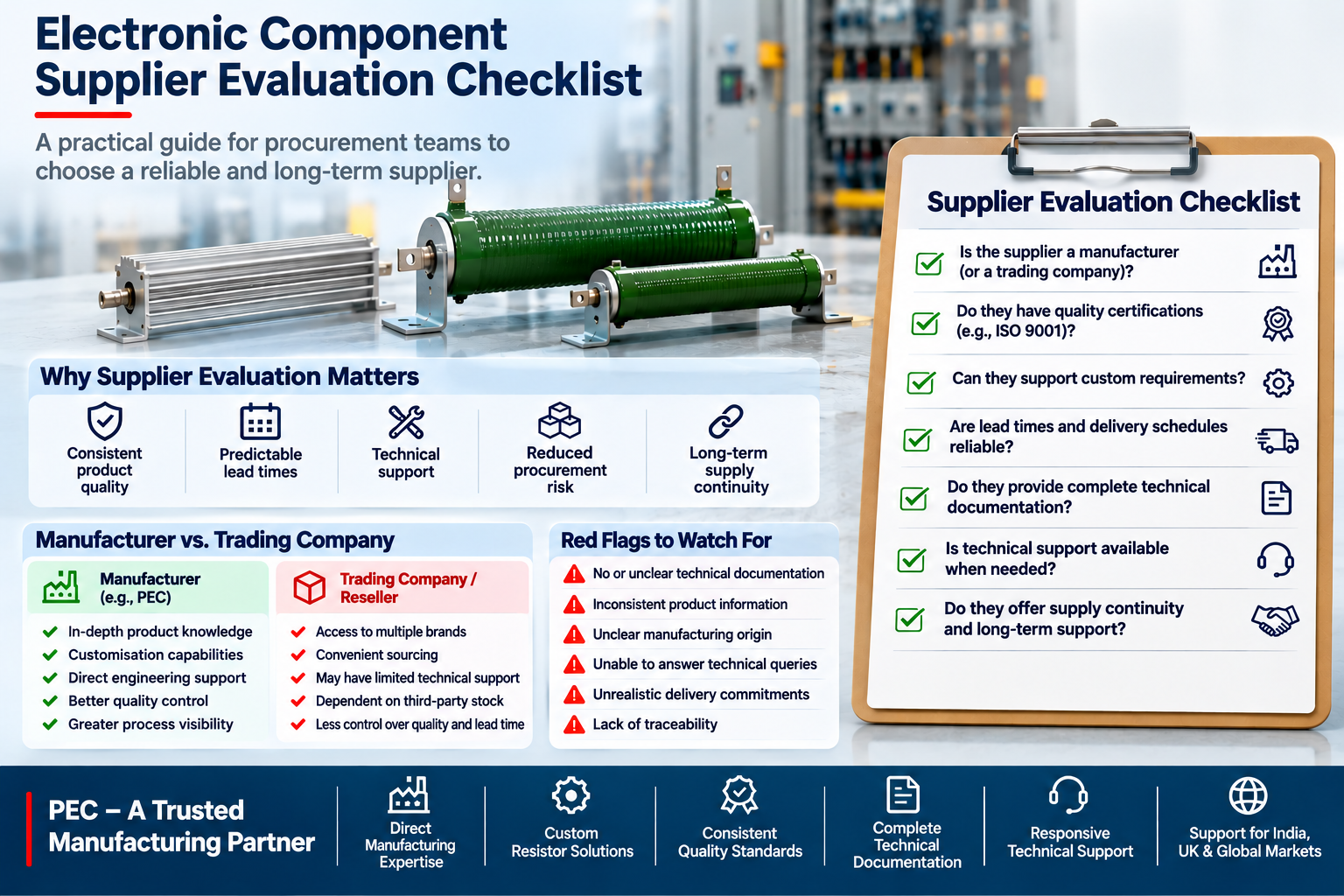
Why Supplier Evaluation Matters More Than Ever
A modern supply chain is only as strong as its weakest supplier.
When a component is delayed, production slows. When specifications vary, quality issues emerge. When technical support is unavailable, engineering teams spend valuable time solving problems that should never have occurred.
For procurement professionals, supplier evaluation is therefore not simply an administrative exercise. It is a risk management strategy.
A well-qualified supplier helps ensure:
- Consistent product quality
- Predictable lead times
- Reliable delivery schedules
- Technical support when required
- Reduced procurement risk
- Long-term supply continuity
The goal is not just to purchase components. The goal is to secure confidence in every future order.
Manufacturing Capability vs Trading: Know the Difference
One of the first questions procurement teams should ask is simple:
Does the supplier manufacture the product or merely resell it?
There is nothing inherently wrong with distributors or trading companies. They often play an important role in the supply chain. However, understanding the difference is essential.
Manufacturers typically offer:
- Greater product knowledge
- Better customisation capabilities
- Direct engineering support
- Improved process visibility
- Stronger quality control
Resellers may provide convenience and access to multiple brands, but they often rely on third-party sources for technical information and production schedules.
For specialised industrial components, working directly with the manufacturer can often simplify communication and improve responsiveness.
Quality Certifications Are More Than Paperwork
Every supplier claims to offer quality products.
The question is how that quality is verified.
Reliable electronic component suppliers invest in structured quality systems designed to ensure consistency from one production batch to the next.
When evaluating suppliers, look for evidence of:
- Quality management processes
- Manufacturing controls
- Product testing procedures
- Inspection standards
- Continuous improvement practices
Certifications are important, but they should be supported by real manufacturing discipline rather than simply appearing on a brochure.
Consistent quality is what prevents costly failures after components reach the field.
Can the Supplier Support Custom Requirements?
Modern projects rarely fit perfectly into standard catalogue offerings.
A resistor may require a specific resistance value. A braking application may need a custom power rating. Environmental conditions may demand a modified enclosure design.
This is where supplier flexibility becomes important.
Strong suppliers can often support:
- Custom electrical specifications
- Special mounting arrangements
- Application-specific designs
- Prototype development
- Production scaling
The ability to adapt to project requirements often becomes a major advantage as applications become more specialised.
Supply Chain Reliability: The Factor Buyers Often Learn Too Late
Imagine finding the perfect component only to discover a twelve-week lead time.
For procurement teams, availability is often just as important as performance.
When evaluating electronic component suppliers, consider:
Lead Times
How quickly can products be supplied?
Inventory Support
Does the supplier maintain stock for frequently ordered products?
Minimum Order Quantities
Can they support both prototype and production requirements?
Scalability
Can they accommodate increasing demand as projects grow?
The most reliable suppliers understand that procurement challenges do not end after the purchase order is issued.
Technical Support and Documentation Matter
A component specification sheet tells only part of the story.
Engineering teams often need additional information before making a sourcing decision.
Reliable suppliers should be able to provide:
- Datasheets
- Compliance documentation
- Test reports
- Material information
- Application guidance
Just as importantly, they should have technical personnel available to answer questions.
When dealing with power resistors and other specialised components, application-specific guidance can often prevent costly specification errors.
A supplier that understands the application is often far more valuable than one that simply ships the product.
Red Flags Procurement Teams Should Watch For
Not every risk is immediately visible.
Certain warning signs often indicate deeper supply chain or quality concerns.
Be cautious if a supplier:
- Cannot provide clear technical documentation
- Offers inconsistent product information
- Has unclear manufacturing origins
- Struggles to answer technical questions
- Provides unrealistic delivery commitments
- Lacks traceability information
Procurement decisions should always be based on evidence rather than assumptions.
A lower initial price can quickly become expensive if quality or availability issues emerge later.
Why Procurement Teams Choose PEC Manufacturing Company
At PEC Manufacturing Company, we understand that procurement teams evaluate suppliers differently than engineers.
Performance matters, but so do consistency, communication and supply reliability.
As a manufacturer of wire wound resistors and power resistor solutions, we support customers across India, the UK and international markets with:
- Direct manufacturing expertise
- Technical application support
- Detailed product documentation
- Customisation capabilities
- Consistent quality standards
- Responsive quotation and support processes
Whether supporting new product development, maintenance requirements or large-scale production projects, our focus remains the same: helping customers source components with confidence.
For additional guidance, explore our articles on Essential Factors When Choosing a Resistor Manufacturer in India and Why Choosing the Right Resistor Manufacturer Matters for Circuit Reliability.
Conclusion
Choosing an electronic component supplier is about much more than comparing prices or checking stock availability.
The right supplier contributes to product quality, production efficiency and long-term business success. Manufacturing capability, quality systems, technical support, supply chain reliability and responsiveness all play a role in determining whether a supplier can support your business effectively.
For procurement teams, the best supplier is not necessarily the cheapest or the largest. It is the one that consistently delivers the quality, reliability and support needed to keep projects moving forward.
At PEC Manufacturing Company, we work closely with procurement professionals and engineering teams to provide dependable resistor solutions backed by manufacturing expertise and responsive support.
Request our supplier evaluation pack to learn how PEC Manufacturing Company can support your sourcing and procurement requirements.