
Introduction
Heat is a constant presence in industrial systems. Motors accelerate and decelerate under load. Drives operate close to their limits. Power supplies run continuously, often for years without interruption. In these conditions, temperature does not appear briefly and disappear. It accumulates, settles into the system, and tests every component over time.
Many resistor failures in industrial equipment are not caused by sudden electrical overload. They are the result of heat that never fully dissipates. As operating hours add up, materials fatigue, resistance begins to drift, and insulation weakens. Wire wound resistors are used in harsh environments because they are designed to operate under sustained thermal stress, not merely withstand short exposure.
Understanding how wire wound resistors manage heat helps engineers and procurement teams select components that remain reliable long after commissioning.
Understanding Harsh Industrial Environments
Industrial environments rarely stress components in isolation. Heat is usually accompanied by vibration, contamination, and repeated load changes.
Typical operating conditions include continuous ambient temperatures between 60 and 85 degrees Celsius, with localized hotspots exceeding 150 degrees Celsius near power devices. Vibration levels often reach 10 to 20 g. Dust, oil mist, and corrosive atmospheres are common. Systems also experience repeated thermal cycling from cold start to full operating load.
In these settings, a resistor must dissipate heat steadily without cracking, drifting, or degrading. Short-term power ratings offer limited insight. Stable thermal behaviour over years of operation is what ultimately determines reliability.
What Is a Wire Wound Resistor?
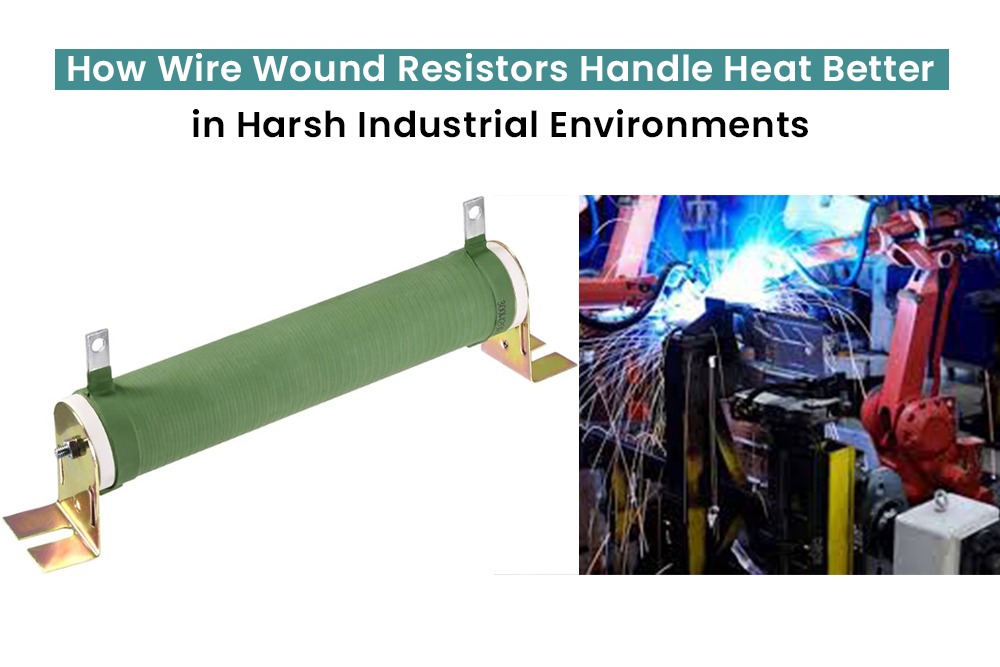
A wire wound resistor uses a resistive metal alloy wire, typically nickel chromium or similar materials, wound around a ceramic core. The assembly is commonly coated with vitreous enamel or housed within a ceramic or metal enclosure.
This construction provides several inherent advantages. The ceramic core offers electrical insulation and high temperature tolerance. The resistive wire maintains stable electrical characteristics even at elevated temperatures. Together, they form a component with high thermal mass and strong mechanical integrity.
Because of this structure, wire wound resistors are well suited for high-power and high-temperature applications found in industrial systems.
Why Heat Is a Critical Design Challenge
Heat influences more than surface temperature. It shapes long-term reliability.
As operating temperature increases, resistance values can drift, insulation ages faster, solder joints weaken, and nearby components experience additional thermal stress. These effects accumulate gradually, even when electrical limits are respected.
In industrial systems that operate continuously at high power, reducing operating temperature by 20 to 30 degrees Celsius can significantly extend component life. Managing heat is therefore not only about preventing immediate failure. It is about slowing aging and preserving performance over time.
Key Design Features That Enable Superior Heat Handling
Wire wound resistors manage heat effectively because their design directly addresses thermal stress.
High-temperature resistive alloys allow the wire element to operate reliably above 300 degrees Celsius, well beyond the limits of carbon or thick-film materials. Ceramic cores tolerate sustained high temperatures while distributing heat evenly along the resistor body, reducing local hotspots. Vitreous enamel or ceramic coatings withstand temperatures up to 350 to 400 degrees Celsius while protecting against moisture and chemicals and improving heat radiation. The larger physical size of wire wound resistors increases surface area, which improves both convective and radiative heat dissipation.
Together, these characteristics allow wire wound resistors to absorb and release heat steadily over extended operating periods.
Heat Dissipation Mechanisms in Wire Wound Resistors
Heat leaves a wire wound resistor through several mechanisms working together.
Thermal energy conducts from the resistive wire into the ceramic core, then transfers to surrounding air through convection, particularly in ventilated enclosures. At higher temperatures, radiation also becomes a significant heat loss path.
This combination allows wire wound resistors to handle continuous power levels from 5 watts up to 500 watts, and even higher in chassis-mounted designs with appropriate cooling. Temperature changes remain gradual and predictable, which supports stable long-term operation.
Wire Wound Resistors vs Other Resistor Types in High-Heat Environments
Resistor technologies respond very differently to sustained heat.
Carbon film resistors exhibit significant drift above 125 degrees Celsius and are unsuitable for continuous high-temperature operation. Metal film resistors offer improved stability but are limited in power handling. Thick film resistors tolerate moderate power but often suffer thermal fatigue over time.
Wire wound resistors maintain electrical stability under sustained temperature and power. In environments where heat is constant, endurance is more important than compact size.
Industrial Applications Where Heat Control Is Critical
Wire wound resistors are widely used in systems where thermal stress is unavoidable.
Motor drives and inverters rely on them for braking, snubbing, and current limiting during repeated load changes. Power supplies and load banks depend on them for continuous high-power dissipation. Industrial heaters and furnaces use them in control and feedback circuits exposed to elevated ambient temperatures. Rail systems, mining equipment, and heavy machinery often operate in enclosed spaces with limited cooling and constant vibration.
In these applications, heat-related failure frequently leads to extended downtime and costly intervention.
Design Practices for Maximizing Thermal Performance
Thermal performance improves when wire wound resistors are mounted on metal surfaces or heat sinks where possible and when airflow around the resistor body remains unobstructed. Power derating above 70 degrees Celsius ambient is common, often in the range of 30 to 50 percent. Enclosure hotspots should be avoided, and sufficient clearance should be maintained to allow radiant heat dissipation.
Working with an experienced Resistor Manufacturer helps ensure that resistor construction matches real operating conditions rather than nominal datasheet assumptions.
Reliability in Harsh Industrial Conditions
Wire wound resistors offer reliability advantages that directly affect system uptime. Resistance remains stable over thousands of operating hours. Components tolerate thermal cycling from minus 55 to plus 155 degrees Celsius. Mechanical construction withstands vibration and shock, and aging behaviour remains predictable rather than sudden.
In environments where maintenance access is limited, this reliability reduces both lifecycle cost and operational risk.
Future Trends in High-Temperature Wire Wound Resistors
Industrial systems continue to evolve, and wire wound resistor design is evolving with them. Higher power density is becoming achievable through improved ceramic materials. More designs integrate directly with chassis-mounted heat sinks. Compatibility with high-temperature power electronics, including SiC devices, is increasing. Electrification and automation continue to raise demand for components capable of tolerating sustained thermal stress.
These trends are driving every serious Electronic Component Supplier to refine wire wound resistor designs for harsher and longer operating conditions.
Conclusion
Heat cannot be eliminated from industrial systems. What matters is how components respond to it over time. Wire wound resistors manage heat effectively because they are built from materials and structures designed for sustained thermal stress without loss of stability.
For organisations designing equipment expected to operate continuously in demanding environments, wire wound resistors offer predictable performance and long service life. Choosing the right Electronic Component Supplier and a proven Resistor Manufacturer ensures that heat remains a managed condition rather than a recurring source of failure.