
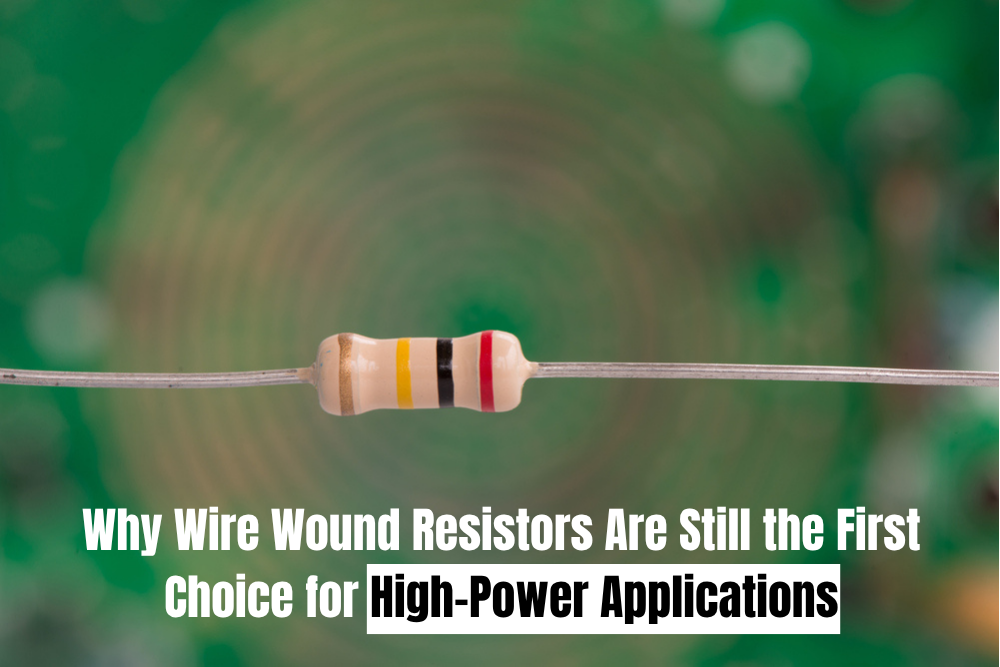
A resistor inside a television and a resistor inside a railway traction system may perform the same electrical function, but they live in entirely different worlds.
One dissipates a few watts inside a controlled environment. The other must absorb kilowatts of energy, survive repeated overloads, tolerate vibration, and continue operating reliably through years of thermal cycling. In high-power systems, a resistor is not simply a passive component. It is an integral part of the system’s safety, reliability and performance.
As industries push towards higher power densities in electric vehicles, renewable energy systems, industrial automation and railway applications, the demands placed on power resistors continue to increase. Despite the emergence of newer resistor technologies, wire wound resistors remain the preferred choice wherever continuous power handling, overload capability and long-term reliability matter most.
Their continued relevance is not a matter of tradition. It is a result of engineering characteristics that few alternative technologies can consistently match.
What Is a Wire Wound Resistor?
A wire wound resistor is manufactured by winding a resistive alloy wire, typically Nichrome or copper-nickel, around a ceramic insulating core. The wound element is then protected using vitreous enamel, cement or aluminium housings that provide electrical insulation, mechanical strength and efficient thermal transfer.
Unlike film resistors, where resistance is created using a deposited resistive layer, wire wound resistors rely on a metallic resistance wire with highly predictable electrical characteristics. This construction provides excellent heat dissipation, mechanical robustness and long-term stability, making wire wound resistors particularly suited to medium- and high-power applications.
The combination of stable resistance alloys and efficient thermal management has made this technology the benchmark for demanding industrial environments.
Why High-Power Applications Demand More
High-power applications operate under conditions that are fundamentally different from conventional electronic circuits.
Motor drives, renewable energy converters, railway traction systems and industrial automation equipment routinely handle high currents, elevated voltages and continuous power dissipation. Components must withstand repeated overloads, rapid switching, high ambient temperatures and constant mechanical vibration without compromising electrical performance.
Under these conditions, thermal management becomes one of the defining factors in system reliability. Excessive heat accelerates material degradation, reduces efficiency and shortens component life. A resistor used in these applications must therefore do much more than provide a specified resistance value. It must safely convert electrical energy into heat while maintaining predictable performance throughout its operating life.
Why Wire Wound Resistors Continue to Lead
Exceptional Power Dissipation
The defining strength of a wire wound resistor is its ability to dissipate large amounts of power continuously.
Its construction allows heat generated within the resistance wire to transfer efficiently through the ceramic core and into the surrounding environment. This enables the resistor to operate safely under sustained electrical loads that would quickly exceed the capabilities of many alternative resistor technologies.
Superior Pulse and Overload Capability
Industrial power systems rarely operate under perfectly steady conditions.
Motor starting, regenerative braking and switching operations frequently generate short-duration current surges. Thanks to their high thermal mass, wire wound resistors can absorb these overload pulses without permanent damage, making them particularly effective in demanding industrial environments.
Excellent Thermal Stability
Resistance values inevitably change with temperature, but the alloys used in wire wound resistors are specifically selected for their relatively low temperature coefficient.
As operating temperatures increase, resistance remains highly stable, allowing circuits to maintain predictable electrical behaviour across a wide thermal range. This stability contributes directly to improved system accuracy and consistent performance.
Long-Term Accuracy
Many industrial applications require resistor values to remain stable not just over hours or days, but across years of continuous operation.
Wire wound resistors exhibit minimal long-term resistance drift, enabling repeatable performance throughout their service life. This characteristic makes them well suited to applications where reliability is more valuable than simply achieving an initial resistance tolerance.
Mechanical Durability
Industrial environments expose components to continuous vibration, thermal cycling and mechanical stress.
The robust construction of wire wound resistors enables them to withstand these demanding conditions with significantly greater resilience than many film-based alternatives, making them a preferred choice for heavy-duty equipment.
Design Flexibility
Wire wound resistors are available in an extensive range of resistance values, power ratings, enclosure types and mounting configurations.
This flexibility allows engineers to select solutions optimised for specific thermal, electrical and mechanical requirements rather than adapting system designs to accommodate component limitations.
Common Types of High-Power Wire Wound Resistors
Wire wound resistors are available in several configurations, each suited to different operating conditions.
Ceramic wire wound resistors are widely used in general industrial equipment due to their excellent balance of power handling and durability.
Aluminium housed resistors improve thermal performance by allowing direct mounting onto heat sinks.
Edge wound resistors are designed for high-current applications where efficient heat dissipation is critical.
For extremely high energy absorption requirements, resistor grids remain the preferred solution in railway traction systems, industrial load banks and heavy manufacturing equipment.
Applications Across High-Power Industries
Wire wound resistors play a critical role across numerous sectors where reliable power dissipation is essential.
In variable frequency drives and servo systems, they function as braking resistors, safely dissipating regenerative energy during motor deceleration.
Power supplies and converters utilise them for current limiting, capacitor discharge and voltage balancing.
Battery testing equipment relies on them for controlled discharge cycles, while renewable energy systems integrate them into braking and protection circuits.
Their durability also makes them indispensable in railway traction, cranes, elevators, industrial load banks and heavy manufacturing equipment, where reliability under continuous duty is essential.
Wire Wound Resistors vs Other High-Power Technologies
Several resistor technologies compete in the high-power market.
Thick film resistors offer compact designs suitable for many electronic assemblies, while metal oxide resistors provide reliable thermal performance for moderate power applications.
However, applications demanding continuous power dissipation, repeated overload capability, mechanical robustness and extended service life continue to favour wire wound resistors.
Their proven ability to perform consistently under severe operating conditions has ensured their continued use across critical industrial infrastructure where component failure is simply not an option.
Addressing the Inductance Challenge
One limitation associated with conventional wire wound resistors is the inductance created by the helical winding of the resistance wire.
Although this characteristic can influence high-frequency circuits, modern manufacturing techniques significantly reduce its impact.
Specialised winding methods such as bifilar and Ayrton-Perry winding effectively minimise inductance while preserving the power handling and reliability advantages of traditional wire wound construction.
As a result, non-inductive wire wound resistors have become suitable for a much broader range of modern electronic applications.
Important Design Considerations
Selecting the right wire wound resistor involves far more than choosing a resistance value.
Engineers should evaluate:
- Resistance value and tolerance
- Continuous power rating
- Pulse energy capability
- Maximum operating voltage
- Ambient operating temperature
- Cooling method and airflow
- Duty cycle and thermal derating
Considering these parameters during the design stage significantly improves long-term reliability.
Common Selection Mistakes
Many resistor failures originate not from manufacturing defects but from specification errors.
Common mistakes include:
- Selecting insufficient power ratings
- Ignoring transient overload conditions
- Restricting airflow around the resistor
- Omitting adequate heat sinking
- Failing to account for continuous duty cycles
Proper installation and thermal management are just as important as selecting the correct resistor itself.
Why Manufacturing Quality Matters
The performance of a wire wound resistor depends as much on manufacturing quality as on its electrical design.
Precision winding, carefully selected resistance alloys, high-quality ceramic cores and rigorous quality control all contribute to stable resistance values, improved thermal behaviour and extended operational life.
For safety-critical industrial systems, manufacturing consistency directly translates into system reliability.
PEC manufactures wire wound resistors using precision manufacturing processes and robust quality standards, supplying components for industrial automation, renewable energy, railway traction and heavy-duty power applications where long-term reliability is essential.
Future of Wire Wound Resistors
The expansion of electric vehicles, renewable energy, industrial automation and energy storage systems continues to increase demand for dependable high-power resistor technologies.
At the same time, advances in resistance alloys, thermal management techniques and manufacturing precision are improving the performance of wire wound resistors even further.
Rather than being replaced by newer technologies, wire wound resistors continue to evolve alongside modern power electronics, remaining one of the most trusted solutions wherever high power, thermal stability and reliability intersect.
Conclusion
High-power electronic systems demand components capable of operating reliably under electrical and thermal conditions that far exceed those found in conventional electronics.
Wire wound resistors continue to meet these demands through exceptional power handling, superior overload capability, thermal stability, long-term accuracy and mechanical durability. Their proven performance across industrial automation, transportation, renewable energy and power conversion systems explains why they remain the preferred choice for engineers designing equipment where reliability cannot be compromised.
At PEC, we manufacture wire wound resistors engineered for demanding industrial environments, supporting applications ranging from motor drives and railway traction to renewable energy and heavy-duty power electronics. When long-term reliability and dependable power dissipation are critical, our engineering team can help specify the right resistor for your application.